

Events
The participatory intermedia installation KOSMICA Parliament by Miha Turšič, co-produced by Cultural Centre of European Space Technologies (KSEVT), Kapelica Gallery, and Delak Institute; Infinite In-Between by Mojca Založnik, produced by Kapelica Gallery; Singing Sand by Tadej Droljc; Maja Smrekar contributing to the Bog Concert Night; and aqua_forensic by Robertina Šebjanič and Gjino Šutić, featuring Aquatocene / The Subaquatic Quest for Serenity by Robertina Šebjanič, also a speaker at a panel and artist talk,
AI – The Other I, a symposium moderated also by Jurij Krpan (Kapelica Gallery), POINT ZERO – Human.0, Machine.0, Data.0, a group exhibition featuring Until I die by [[::vtol::]], a screening of Nighthawk by Špela Čadež, produced by Finta and supported by the Slovenian Film Centre, We Should Take Nothing for Granted! Listening Conditions for an Alert and Knowledgeable Citizenry by Matthew Biederman and Marko Peljhan and produced by Projekt Atol Institute, and Semiotics of the Laboratory by Špela Petrič, Günter Seyfried, Roland van Dierendonck, Miha Turšič and Slavko Glamočanin
Aurelia 1+Hz / proto viva generator by Robertina Šebjanič, Liminoid by Saša Spačal and Matic Potočnik (Ljudmila Art and Science Laboratory), and Self-Portrait by Boštjan Čadež at the festival Device_art 5.015, with curator Sandra Sajovic (Kapelica Gallery), organised in collaboration with Kapelica Gallery,

Programme
The gallery's programme focuses on the art production that has been scarce or completely absent in other Slovene galleries and is divided into four main thematic groups: installations and ad hoc projects, technology through art, science through art, and corporeality through art.
With a programme which consists of spatial installations, performances, sound research and theoretically-reflective lectures, Kapelica Gallery challenges scientific and technological applications, biopolitics and urban phenomena, addressing both professional and general public. The Gallery programme is developed as a response to the profound changes in society, thus it is constructed from art activities that reflect the multitudes of contemporaneity and announce the possible future scenarios.
Some of the international artists who have been presented at the gallery are: Survival Research Laboratories, Stelarc, Marcel Li, Chico Mc Murphy, Franco B., Orlan, Ron Athey, etc. Jurij Krpan frequently works with the following local artists: Marko Peljhan, Tao G. Vrhovec Sambolec, Marko Batista, Sašo Sedlaček, Sanela Jahić, Žiga Kariž, Janez Janša, Stefan Doepner, Borut Savski, Polona Tratnik, Ive Tabar, and Eclipse.
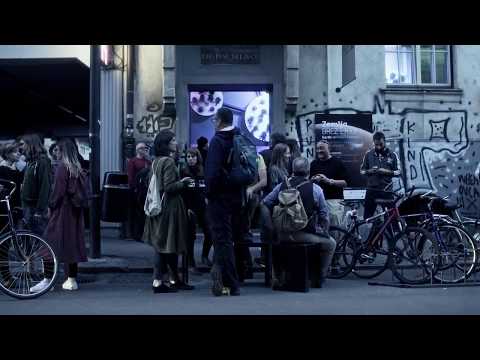
International collaboration
The Kapelica Gallery has established links with numerous galleries and initiatives abroad (including the UK's Live Art Development Agency), working with many guest curators, artists and theoreticians of contemporary artistic practice.
Trust me, I’m an Artist is a project carried out by eight European partners, in which they addressed and discussed the ethical frames of the contemporary Western society, which limit artistic expression in a number of ways. The Kapelica Gallery focused on questioning the ethical issues in contemporary research art.
The European Digital Art and Science Network project connected The Kapelica Gallery with two of the best scientific laboratories in the world: The European Space Agency in the Netherlands and the European Southern Observatory in the Atacama Desert in Chile. Through public tenders the international initiative offered an opportunity to artists from Europe to cooperate with experts from the aforementioned scientific and research platforms.
See also
External links
- Jurij Krpan lectures on VideoLectures.Net (in Slovenian)
Gallery


.jpg)


