Ulay
Widely regarded as one of the most important figures in post-war art, Ulay moved to Amsterdam in the mid-1960s. From there he produced an important body of work in photography and performance art, much of the latter in collaboration with Serbian artist Marina Abramović.
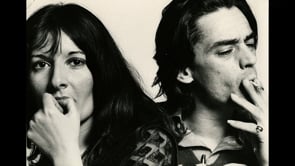
While his work centred on notions of the body and identity, Ulay was also keenly aware of the political dimensions of art, with one of his most celebrated "actions" being the theft, from a Berlin museum, of one of Hitler's favourite paintings, which he then hung in the apartment of an immigrant Turkish family ("There Is a Criminal Touch to Art", 1976).
Ulay in Slovenia
His later work was similarly socially engaged, reflecting his concerns about, among other things, the deterioration and privatisation of water resources. Indeed, two of his Slovenia-based projects explored this subject: the installation Whose Water Is It? and the online gallery Earth Water Catalogue, both of which were produced by Nastati during Maribor's tenure as European Capital of Culture in 2012.
Ulay's time in Ljubljana was also marked by several exhibitions of his work, including I Other (City Art Gallery, 2017) and Nastati (which means "to become"), the exhibition of some of the artist's early photographs staged in the Škuc Gallery in 2009.
Ulay's ties with Slovenia were further cemented in 2013 with the release of a feature-length documentary on the artist, Project Cancer, by acclaimed director Damjan Kozole.
Activities of the Foundation
The Ulay Foundation was registered as Stichting Ulay in Amsterdam in 2013. It exists to preserve, promote and archive the artist's work, as well as to explore the forward directions of the two (interconnected) disciplines, photography and performance, that he helped to shape so radically during his career.
Through its network of residencies, the Foundation aims to encourage young and emerging artists to engage with his legacy. One such residency is offered to pairs of artists or curators in almost any field of the arts at Ulay's harbour-front house in Piran, which was renovated for the purpose by famed Slovenian architects Bevk Perovič. Before he died, Ulay also established a nomadic residency programme, which provides funds (as well as a suitcase containing a Polaroid camera, a laptop, a scarf and other items) to a selected artist to allow them to engage with his legacy as they travel.
Although the Ulay Foundation Project Space was officially launched in late 2019, the artist's declining health meant that he was unable to see it become fully operational before his death. The artist himself made clear that the space would not be a gallery in any conventional sense, but a platform (or a "connecting point" as he himself called it) for incorporating a number of different disciplines – much like Nastati before it.
Archive and 2020/21 retrospective
The archive is managed by Lena Pislak, the executor of Ulay's estate. The Foundation is also in charge of organising and cataloguing the artist's considerable body of work, and supporting its exhibiting such as the largest retrospective of his work to date, Ulay Was Here, 2020 and April 2021 at the Stedelijk Museum in Amsterdam (2020) or Art Vital – 12 Years of Ulay / Marina Abramović at the Cukrarna Gallery in Ljubljana.
See also
External links
- Article on the Foundation Project Space, with details of the Stedelijk retrospective, artnet, April 2020
- Introduction to the Stedelijk retrospective
- Video tour of the Stedelijk retrospective by Rein Wolfs, museum director (in Dutch with English subtitles)
- Ulay Foundation Project Space interior design by Mertelj Vrabič Arhitekti, Outsider (2020)
Gallery
.jpg)
.jpg)
